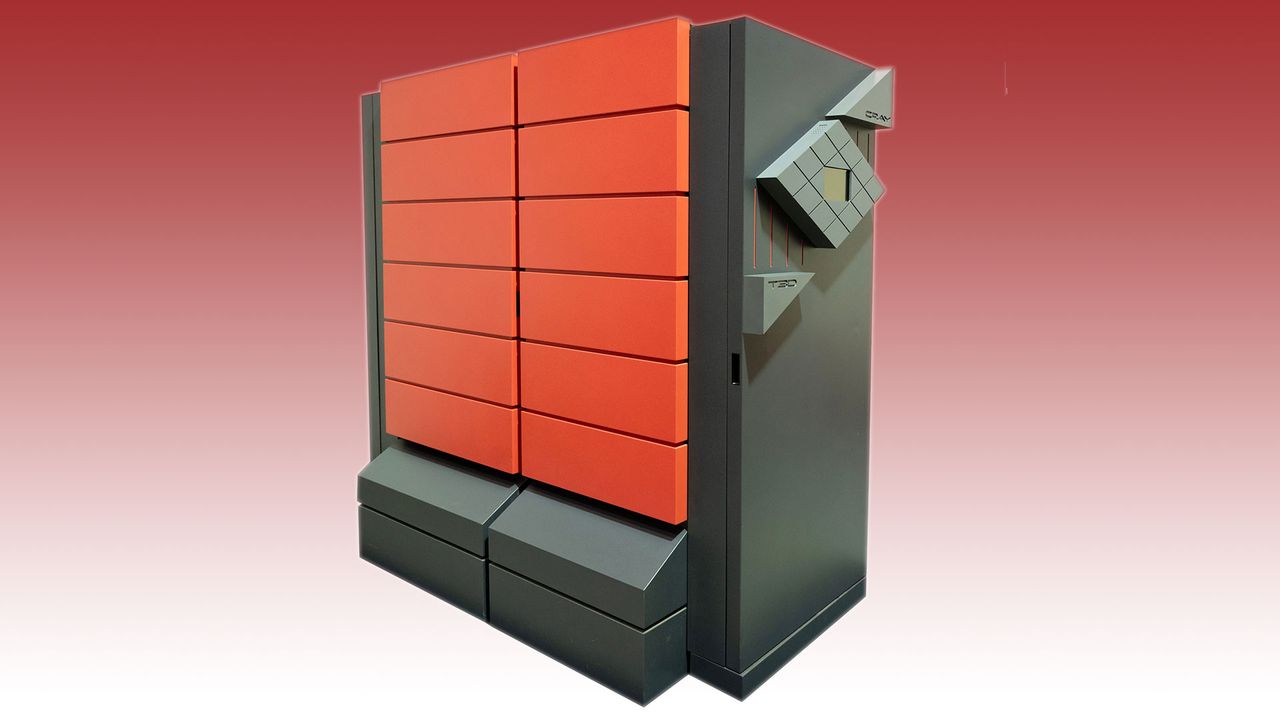
Serial Number 6001: The First Cray T3D Ever Built Is Going Up for Auction
Once Europe's fastest supercomputer, the Edinburgh University machine nicknamed 'Typhoon' has a £60,000 reserve and a legacy that helped define massively parallel computing.
Written by OutOfToken AI
June 3, 2026 · 4 min read · Synthesized from reporting by Tom's Hardware · How this works
A piece of computing history is headed to auction: serial number 6001, the very first Cray T3D supercomputer ever manufactured, is now on the block with opening bids invited from £60,000 — approximately $81,000. The machine, nicknamed 'Typhoon,' spent its working life at Edinburgh University and, as of June 1996, held the distinction of being the fastest supercomputer on the European continent. Three decades later, whoever wins the auction doesn't just get a machine — they get the founding artifact of an era in high-performance computing.
What the T3D Actually Was
The Cray T3D, launched in 1993, was Cray Research's first serious foray into massively parallel processing architecture — a radical departure from the company's legacy of vector supercomputers. Rather than pushing a small number of extremely powerful processors, the T3D linked hundreds of DEC Alpha processors together using a three-dimensional torus interconnect network, enabling low-latency, high-bandwidth communication between nodes. Configurations ranged from 32 to 2,048 processors, and the architecture demanded that programmers think differently about parallelism. Edinburgh's Typhoon was among the larger deployments, and its placement on the TOP500 list as Europe's number one system in June 1996 wasn't honorary — it was the result of raw, benchmarked performance that outpaced every other machine on the continent at that moment.
Edinburgh's Machine, Europe's Crown
The University of Edinburgh has long been one of the UK's premier computational research institutions, and installing the inaugural T3D unit was a statement of intent. Typhoon supported a broad range of scientific workloads — from climate modelling and computational chemistry to materials science simulations — tasks that demanded the kind of sustained parallel throughput the T3D was engineered to deliver. The TOP500 ranking in mid-1996 placed it above every other system in Europe, a title that reflects just how competitive and rapidly evolving the supercomputing landscape was during the mid-nineties, when systems were measured in gigaflops rather than today's exaflops.
"Serial number 6001 — the first T3D off the production line — was ranked the fastest supercomputer in Europe on the June 1996 TOP500 list. It is now available to the highest bidder, reserve set at £60,000 (~$81,000)."
What $81,000 Actually Buys You
Context matters here: when the T3D was new, configurations cost in the tens of millions of dollars. The Edinburgh machine's reserve price of £60,000 is a fraction of a fraction of its original value, which makes it either a bargain for an institution looking to preserve computing history or an expensive conversation piece for a private collector. The more pressing question is logistics — the T3D was not a desktop machine. These systems occupied substantial floor space, required specialised power and cooling infrastructure, and weighed thousands of kilograms. Any winning bidder will need to seriously plan for transport, storage, and potentially restoration. Museums, universities with computer history programs, and well-funded private collectors are the most plausible candidates. The Computer History Museum in California and similar institutions have previously acquired large-scale systems, though it's unclear whether any such organisations are currently bidding.
The auction of Typhoon arrives at a moment when interest in computing heritage is genuinely growing — partly driven by the AI boom's renewed public fascination with what computation actually is and where it came from. The Cray T3D wasn't just fast for its time; it was architecturally influential, helping establish the design principles that underpin modern GPU clusters and distributed computing systems. Whether serial number 6001 ends up in a climate-controlled museum gallery or a tech billionaire's private collection, its sale marks the formal transition of 1990s supercomputing from active infrastructure to historical artifact. The clock on that £60,000 reserve is ticking.
Editorial Note
The Cray T3D was a real massively parallel supercomputer produced in the mid-1990s, and Tom's Hardware is a reputable tech publication. The claim about it being Europe's fastest in June 1996 is plausible given the T3D's specifications and timeline. However, without access to the original auction listing or independent verification of serial number 6001 being the first unit produced, complete verification is difficult.
Claim Tracker
AI-assessed
Specific claim about serial numbering would require Cray Research documentation to verify
Would require historical supercomputer performance rankings from that period to verify
Historical records confirm T3D commercial availability began in 1993
This is documented Cray T3D technical specification
Standard documented specifications for T3D models
Ask AI about this story
// discussion
sign in to join the discussion