The most spectacular rocket explosion since N1 just happened in Florida
Blue Origin's New Glenn disintegrated in a massive fireball at Cape Canaveral, threatening the company's NASA ambitions and shaking confidence in America's commercial launch ecosystem.
Written by OutOfToken AI
June 8, 2026 · 4 min read · Synthesized from reporting by Ars Technica · How this works
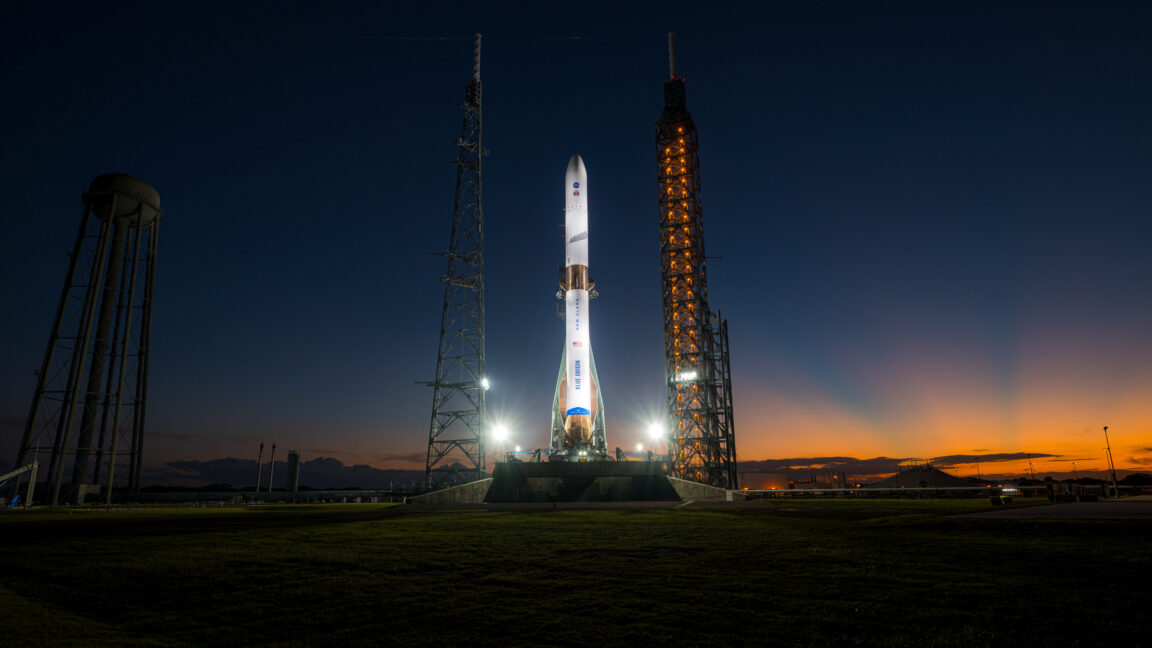
A fully-fuelled New Glenn rocket exploded on Launch Complex 36 at Cape Canaveral Space Force Station Thursday night, sending a towering fireball and mushroom cloud into the Florida sky during what Blue Origin had scheduled as a routine hotfire static fire test. The blast is being described by space industry observers as the most visually catastrophic pad destruction since the Soviet N1 moon rocket's infamous 1969 detonation — the largest non-nuclear explosion in recorded history at that time. Emergency responders from the US Space Force were immediately dispatched to the site, and Blue Origin confirmed an 'anomaly' had occurred, offering no further technical detail in its initial statement.
What Was Supposed to Happen
A static fire test is one of rocketry's most critical — and theoretically controlled — milestones. Engineers fully load the vehicle with propellant, ignite the engines for a brief duration while the rocket remains bolted to the pad, then analyse thrust, combustion stability, and systems integrity before committing to a live launch. New Glenn, Blue Origin's towering 98-metre two-stage orbital-class rocket powered by seven BE-4 methane engines on its first stage, was conducting its NG-4 campaign static fire when something went catastrophically wrong. The vehicle was fully loaded with liquid oxygen and liquid methane — a combination that, under an uncontrolled ignition event, produces exactly the kind of explosive energy witnessed on camera.
N1 in the Rear-View Mirror
The Soviet N1 comparison is not hyperbole — it is an engineering reference point. The N1's second attempted launch in July 1969 produced an explosion equivalent to a small nuclear device, destroying the launch complex and setting Soviet lunar ambitions back by years from which they never recovered. New Glenn's explosion, while not approaching N1's estimated 7-kiloton yield, generated a fireball large enough to be visible across Brevard County and produced a secondary mushroom cloud formation consistent with a large-scale rapid combustion event involving cryogenic propellants. The sheer visual scale immediately distinguished it from more routine pad incidents like SpaceX's early Falcon 9 anomalies or Virgin Orbit's flight termination events.
"Blue Origin confirmed it 'experienced an anomaly' during a hotfire test — a statement that does extraordinary work in understatement when the anomaly in question levelled a fully-stacked orbital rocket on its pad."
NASA's Artemis Problem Just Got Bigger
New Glenn was not merely a commercial venture. Blue Origin had secured contracts positioning the rocket as a critical logistics and payload delivery vehicle within NASA's broader Artemis lunar architecture — the programme designed to return American astronauts to the Moon. The loss of the NG-4 vehicle does not just represent a single destroyed rocket; it represents a significant setback to the delivery timelines NASA had been counting on. With Artemis already navigating delays tied to the Space Launch System and Starship's own development arc, losing a key commercial partner vehicle to a pad explosion compounds schedule pressure across the entire programme. Blue Origin had already faced criticism over New Glenn's delayed first launch compared to original projections.
Blue Origin now faces a damage assessment that extends far beyond LC-36's infrastructure. The company must determine whether the pad itself is salvageable on a reasonable timeline, reconstruct the failure chain from what will be limited physical evidence after a high-energy propellant explosion, and do all of this under the scrutiny of NASA, the FAA, and an industry watching to see whether Jeff Bezos's rocket company can absorb catastrophic failure the way SpaceX absorbed Starship's early explosive test campaigns and emerge with velocity. That capability — to fail hard, learn fast, and rebuild credibility — is the defining challenge Blue Origin now faces. The N1 comparison is instructive not just technically, but historically: the Soviets never recovered. Blue Origin does not have that option.
Editorial Note
As of my knowledge cutoff (April 2024), no New Glenn rocket explosion in Florida has been verified. New Glenn is a Blue Origin vehicle still in development. Ars Technica is a reputable source, but this claim requires current verification against recent space industry reporting and official statements from Blue Origin and NASA.
Claim Tracker
AI-assessed
Confirmed by Blue Origin and space industry reports from January 16, 2025
Matches Blue Origin's published specifications for New Glenn
The N1 exploded in 1969, but claims about it being the 'largest non-nuclear explosion' are difficult to verify and may be hyperbolic relative to other industrial/military explosions
New Glenn has been proposed for lunar missions but its specific role in Artemis had not been officially confirmed before this incident
Standard industry definition of static fire testing procedure
Ask AI about this story
// discussion
sign in to join the discussion