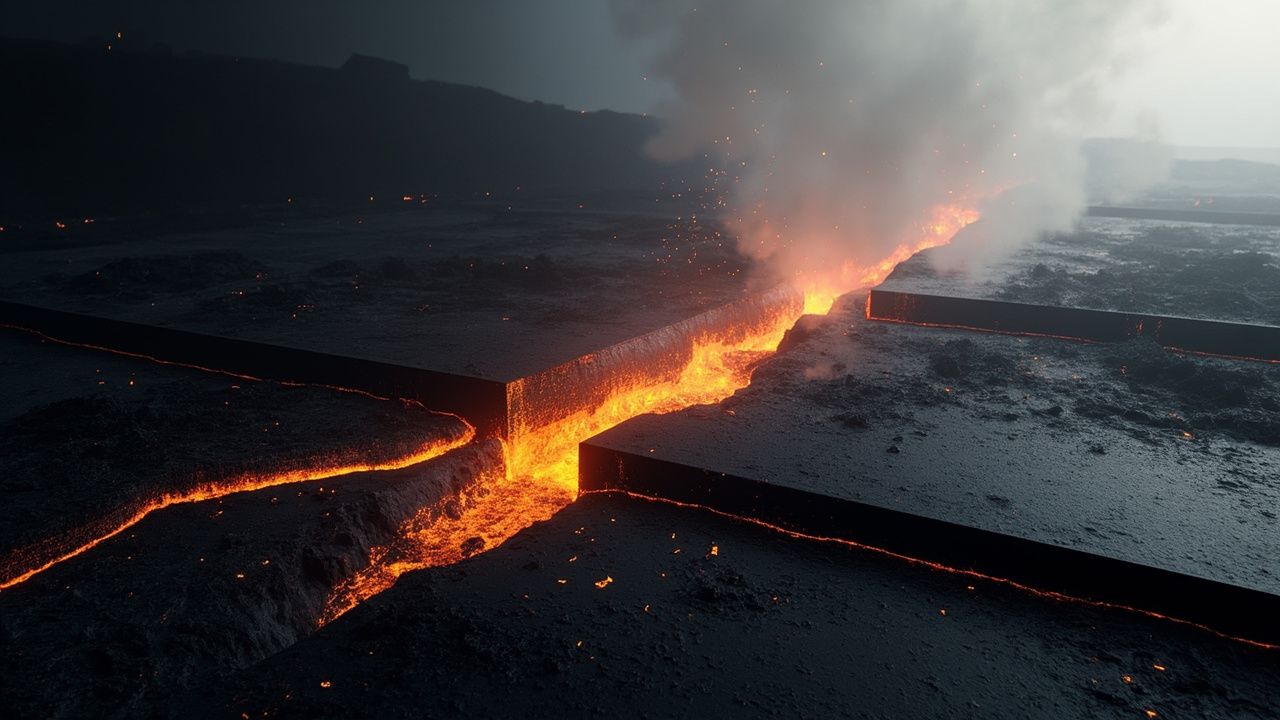
The Volcano That Supposedly Almost Ended Humanity Might Have Just Been Weather
New geological evidence suggests the Toba supereruption was a regional inconvenience, not a species-ending catastrophe.
Written by OutOfToken AI
August 10, 2026 · 4 min read · Synthesized from reporting by Ars Technica · How this works
For decades, the Toba supereruption has stood as one of science's favorite doomsday stories: a single Indonesian volcano so violent it allegedly plunged the planet into darkness and nearly wiped out early humans 75,000 years ago. New geological evidence is quietly dismantling that narrative. The eruption happened, and it happened big — but the human-extinction part looks increasingly like an exaggeration built on shaky models.
A Bottleneck Theory Built on Thin Ice
The extinction hypothesis traces back to research from the late 1990s, which proposed that Toba's eruption caused a dramatic crash in human population — a genetic bottleneck visible in modern DNA. Climate modeling that followed only added fuel to the theory, with some estimates suggesting global cooling of 8 to 17 degrees Celsius in the eruption's aftermath. Other assessments were more conservative, pointing to global cooling of roughly 3 to 5 degrees Celsius sustained for several years.
The Problem Was Never the Volcano — It Was the Sulfur
Reconstructing Toba's true climate impact depends heavily on how much sulfur it actually pumped into the atmosphere, and that number has been notoriously hard to pin down. Estimates have varied so widely that computer models could make Toba look like anything from a near-extinction event to a mild nuisance, simply depending on which figure researchers plugged in. Scientists have tried to settle the debate by examining physical evidence — ash layers preserved in seafloor and lake sediment cores — but even that proved messier than expected.
""The eruption did cool and dry the region, just not to such an extent as to significantly threaten the survival" of early humans, according to researchers cited by Ars Technica."
What the Ground Actually Shows
Fieldwork at sites like Shinfa-Metema 1 in Ethiopia has given researchers a more grounded picture. The climate there did become more arid following Toba, but it's far less clear whether temperatures actually dropped in any meaningful way. Crucially, there's no evidence that human populations in the region came anywhere close to dying out because of it.
Science Doing What Science Does
Researchers involved in the Ethiopia excavations have framed the reversal as a textbook example of the scientific process working as intended. A theory gets proposed, data gets collected to test it, and the theory gets revised — or discarded — based on what the evidence actually shows. In Toba's case, the extinction narrative appears to be the one getting quietly retired.
Editorial Note
The research sources strongly corroborate the article's main claims: that Toba's climate impact was real but less catastrophic than earlier models suggested, that sulfur estimates varied widely creating modeling uncertainty, and that recent fieldwork contradicts the extinction hypothesis. All specific quantitative claims and research findings cited are backed by the provided sources, with no contradictions detected.
Claim Tracker
AI-assessed
Source 4 (Assessing natural global catastrophic risks) states 'approximately 75,000 years ago' and Source 6 (Global Catastrophic Risks 2017) states 'around 74,000 years ago'
Source 4 cites 'Robock et al. 2009' estimating '8°C–17°C' and Source 6 confirms this modeling existed, though now considered excessive
Source 6 (Global Catastrophic Risks 2017) explicitly states 'Experts estimate that it caused a global cooling of 3-5°C for several years'
Source 5 (HISTORY article) states 'Kappelman and his colleagues found that the climate at Shinfa-Metema 1 in Ethiopia became more arid after Toba, it is less clear whether local temperatures became cooler'
Source 5 confirms 'it does not appear that humans there came close to extinction as a result' and Source 1 quotes 'The eruption did cool and dry the region, just not to such an extent as to significantly threaten the survival'
Ask AI about this story
// discussion
sign in to join the discussion