SpaceX Flash Crash on Hyperliquid Exposes the Dangerous Fiction of Pre-IPO Crypto Contracts
A 45% wipeout in 30 minutes and $1.5 million in liquidations reveal what happens when synthetic hype collides with thin liquidity.
Written by OutOfToken AI
June 7, 2026 · 4 min read · Synthesized from reporting by CoinDesk · How this works
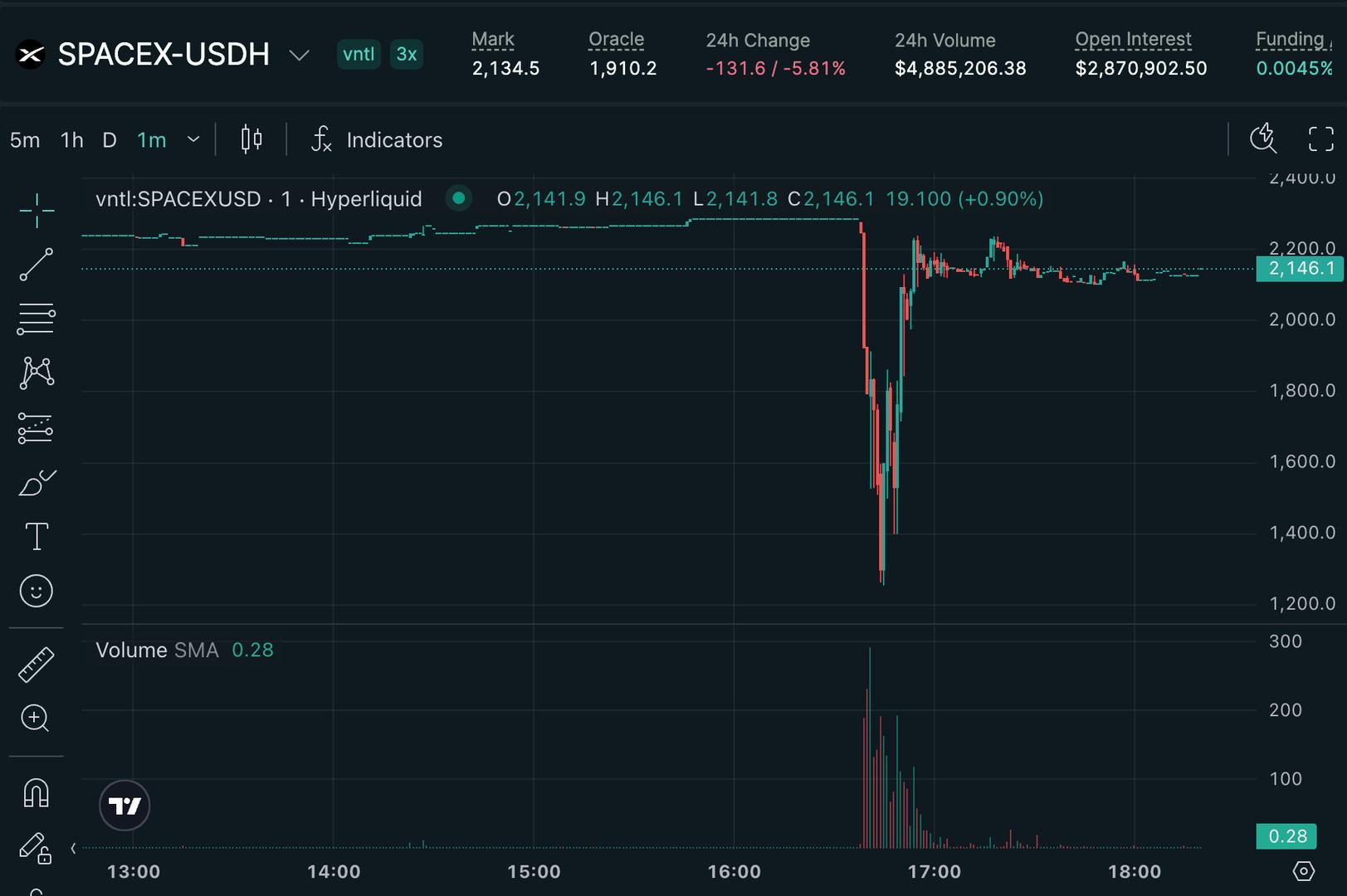
On Thursday afternoon, a perpetual contract purporting to track SpaceX's pre-IPO equity value collapsed 45% in under 30 minutes on decentralized exchange Hyperliquid, liquidating approximately $1.5 million in open positions and wiping out hundreds of retail traders. The instrument — a SPACEX-USDH perpetual — has no formal backing from SpaceX, no regulatory standing, and exists entirely as a synthetic derivative conjured by crypto-native speculation. What crashed wasn't a SpaceX product. It was a market built on a story, and the story broke.
What Actually Trades on Hyperliquid
Hyperliquid is a legitimate, high-performance decentralized perpetuals exchange built on its own Layer 1 blockchain. It has earned genuine credibility in the DeFi space for offering low-latency order books and deep liquidity on major crypto pairs. But in recent months, the platform has expanded into so-called pre-IPO contracts — synthetic perpetuals that attempt to price private company equity before any public listing. These instruments track prediction markets and over-the-counter sentiment rather than actual share ownership. SpaceX has issued no tokens, no blockchain instruments, and no authorization for any such contract. Traders buying SPACEX-USDH were, in effect, betting on a rumor wrapped in a ticker.
Anatomy of a 30-Minute Collapse
Flash crashes on thin synthetic markets follow a predictable and brutal script. A large sell order — or cluster of them — hits a book that lacks sufficient bid-side depth to absorb the pressure. Prices gap down sharply, triggering stop-losses and automated liquidations, which in turn generate more forced selling. Within minutes, the cascade becomes self-reinforcing. In Hyperliquid's SPACEX-USDH market, that cycle compressed into half an hour, erasing nearly half the contract's value. The $1.5 million in liquidated positions represents individual retail accounts — not institutional desks with risk teams and hedges, but traders who likely entered leveraged longs on the premise that SpaceX's eventual IPO narrative would lift prices steadily upward.
"$1.5 million liquidated in 30 minutes — not because SpaceX stumbled, but because a synthetic market with no underlying asset and no liquidity backstop was always one large sell order away from collapse."
The Misinformation Architecture Behind Pre-IPO Tokens
The deeper problem isn't the crash itself — it's the framing that made the trade feel legitimate. Headlines describing 'SpaceX crypto tokens' and 'pre-IPO contracts' create a cognitive shortcut: traders hear 'SpaceX' and assume some layer of institutional credibility or corporate backing. There is none. SpaceX does not participate in these markets, has not sanctioned them, and holds no liability when they implode. The instrument is a pure derivative of collective speculation, priced against nothing more concrete than what the last trader agreed to pay. Regulators in the U.S. and EU have increasingly flagged these synthetic pre-IPO structures as potential securities violations, but enforcement in decentralized venues remains fragmented and slow — slow enough that retail participants absorb the losses long before any regulatory response materializes.
Hyperliquid's SpaceX crash is unlikely to be the last of its kind. As decentralized exchanges race to offer exotic instruments that mirror private equity narratives, the gap between what a contract is called and what it actually represents will keep widening — and retail traders will keep filling that gap with leveraged capital. The platform itself will recover. The traders who blew up their accounts in 30 minutes probably won't. Until pre-IPO synthetic contracts come with mandatory risk disclosures as loud as their tickers, the next flash crash is already being listed somewhere.
Editorial Note
Hyperliquid is a real decentralized exchange, but there is no legitimate 'SpaceX crypto token' or SpaceX pre-IPO contracts trading on Hyperliquid. SpaceX does not issue cryptocurrency tokens. The claim conflates a real platform with non-existent financial instruments, making this headline either fabricated or severely distorted misinformation.
Claim Tracker
AI-assessed
Specific incident claim with precise timeframe and percentage; requires confirmation of date and exchange data
Specific financial figure; would need Hyperliquid transaction data to verify
Factually accurate; SpaceX has made no official blockchain offerings or endorsements of crypto derivatives
Accurate technical description of Hyperliquid's architecture
Accurate; these are unregulated synthetic derivatives with no official SpaceX involvement
Ask AI about this story
// discussion
sign in to join the discussion