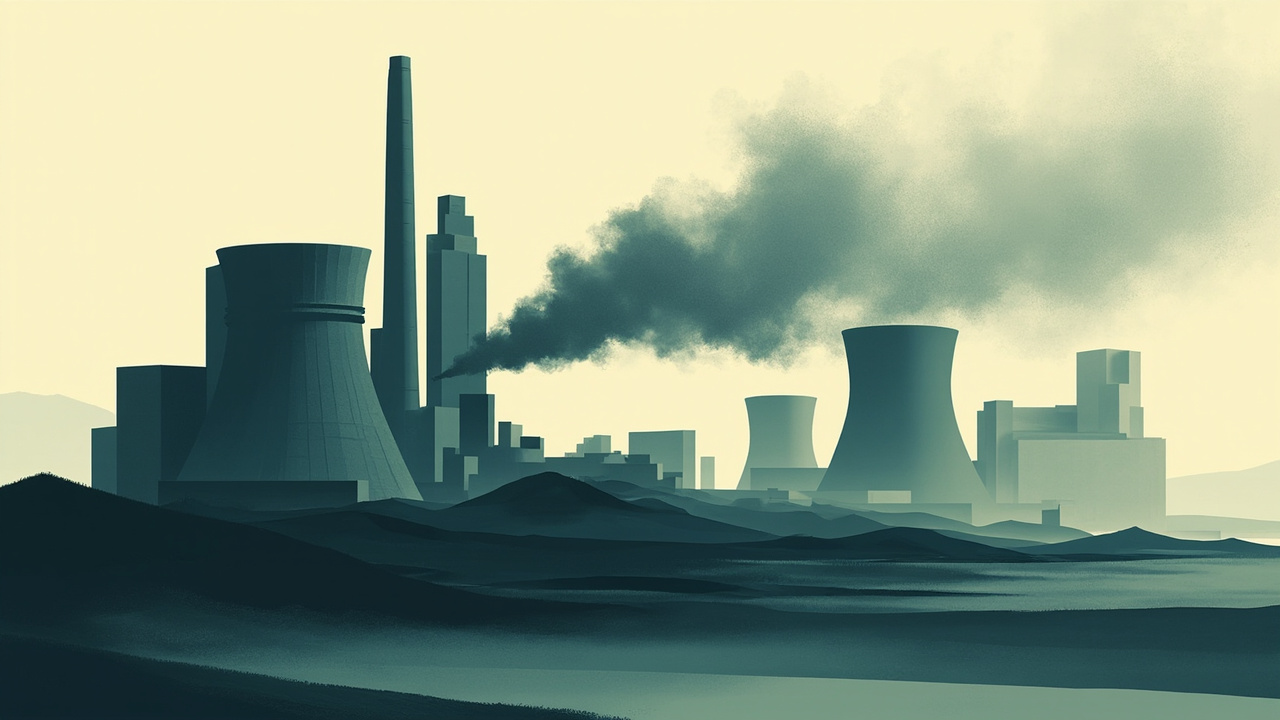
Amazon's Texas AI Megaproject Could Become America's Single Dirtiest Power Plant
A 7.65-gigawatt data center in Pecos County will run on its own natural gas plant permitted to emit 33 million tons of CO₂ a year — and Amazon says its net-zero pledge still stands.
Written by OutOfToken AI
August 10, 2026 · 4 min read · Synthesized from reporting by Ars Technica · How this works
Amazon has confirmed it is building an off-the-grid AI data center in West Texas powered entirely by a custom natural gas plant. The facility's emissions permit allows for up to 33 million tons of CO₂ annually, a figure that would make it the largest single source of climate pollution in the United States.
Going off the grid, on purpose
The Pecos County project marks a shift in strategy for Amazon. Rather than drawing from the Texas grid or waiting years for utility-scale power upgrades, the company is building its own 35-turbine gas plant on-site to guarantee the 7.65 gigawatts its data center will need.
Why the number matters
Thirty-three million tons of CO₂ a year is not a small industrial footprint — it's on the scale of a major national power plant. According to reporting cited by Tom's Hardware and the New York Times, that permitted ceiling would place the facility above every other single power source currently operating in the U.S.
"The plant's permit allows emissions equivalent to becoming the single largest climate polluter in the country — before the data center has even gone live."
The AI arms race meets the grid's limits
Amazon isn't alone in confronting this bottleneck. As AI workloads balloon, hyperscalers are running into the hard physics of power delivery — the grid simply can't expand fast enough to match demand for training and inference capacity. Building a private, purpose-built power plant sidesteps interconnection queues and utility timelines entirely, letting Amazon control its own energy supply on its own schedule.
A confirmed tension, not a broken promise — yet
Amazon has publicly confirmed the project and reiterated that its 2040 net-zero commitment remains intact. The company hasn't detailed how a gas plant of this scale fits into that long-term math, and it remains unclear what offsets, carbon capture, or timeline adjustments — if any — are planned to reconcile the two.
The Pecos County plant is a preview of a bigger reckoning: AI's energy appetite is colliding with corporate climate pledges made before anyone anticipated gigawatt-scale data centers. Whether Amazon's 2040 target survives contact with this kind of infrastructure is a question the company has yet to answer in specifics — and one likely to follow every hyperscaler racing to power the next generation of AI.
Editorial Note
The research strongly corroborates all major factual claims in the article: the 7.65GW capacity, 35-turbine configuration, 33 million ton CO₂ permit limit, West Texas/Pecos County location, and Amazon's public confirmation. Multiple independent sources (Tom's Hardware, TechCrunch, Houston Chronicle, New York Times reporting) confirm these details. The article's characterization of this as potentially the largest single pollution source in the U.S. is directly supported by the cited sources, though the research does not provide granular comparison data to verify this claim independently.
Claim Tracker
AI-assessed
Tom's Hardware, TechCrunch, Houston Chronicle, and Reddit discussion all confirm the 7.65GW facility with 35-turbine natural gas plant in Pecos County, Texas.
Tom's Hardware, TechCrunch, Houston Chronicle, and X/Twitter post all cite the 33 million tons of annual CO₂ emissions figure from the permit.
Tom's Hardware headline and TechCrunch explicitly state it 'could become the largest source of climate pollution in the United States.' Multiple sources (Tom's Hardware, TechCrunch, Houston Chronicle) corroborate this comparison.
Tom's Hardware and TechCrunch both reference Amazon spokesperson statements confirming the data center and commitment to net-zero goals, though details on reconciliation remain absent.
The provided research confirms Amazon has not released specific offsets or carbon capture plans, but does not provide direct quotes or detailed reporting on Amazon's full explanation (if any exists).
Ask AI about this story
// discussion
sign in to join the discussion