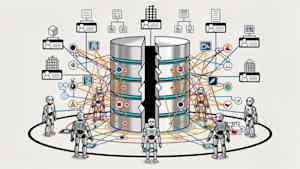
D&B's database of 642 million businesses was built for humans, not AI agents. So they rebuilt it.
Dun & Bradstreet's Commercial Graph overhaul is the starkest proof yet that enterprise data infrastructure designed for people will collapse under autonomous AI.
Written by OutOfToken AI
May 24, 2026 · 4 min read · Synthesized from reporting by VentureBeat · How this works
For 180 years, Dun & Bradstreet built the world's most comprehensive commercial intelligence layer — 642 million businesses, 11,000 fields per record, roughly 100 billion data quality checks executed every month. It was a masterpiece of enterprise data architecture, tuned for credit analysts who could afford to wait, risk managers who could tolerate ambiguity, and sales professionals who knew how to interpret a messy entity match. Then AI agents arrived, and the whole edifice started showing cracks.
The architecture mismatch nobody anticipated
When D&B's nearly 200,000 global customers began threading autonomous agents into credit decisioning, procurement workflows and supply chain risk monitoring, the Commercial Graph did not fail dramatically — it failed quietly and persistently. Agents do not tolerate latency the way humans do. They cannot pause on an ambiguous entity resolution and make a judgment call. They do not contextualize a slow query result against prior domain experience. What they need is deterministic, low-latency access to structured data at a speed and resolution that legacy enterprise databases were simply never designed to deliver. D&B's infrastructure, however robust, was fundamentally a human-facing system being asked to serve machine-speed clients.
Rebuilding for sub-second machine consumption
D&B's response was a ground-up architectural rethink of the Commercial Graph rather than a patch-and-optimize approach. The rebuilt system is engineered to deliver query responses at sub-second latency, a threshold that sounds modest until you consider the data complexity involved — corporate hierarchies spanning multiple jurisdictions, risk profiles drawing on hundreds of proprietary and third-party signals, and relationship graphs connecting entities across industries and geographies. The 11,000 fields per record that once served as a deep research resource for human analysts have been restructured so that agents can traverse and retrieve relevant subsets programmatically, without the disambiguation steps that human workflows absorbed invisibly.
"642 million businesses. 11,000 fields per record. 100 billion data quality checks per month. All of it rebuilt so an AI agent can get a deterministic answer before a human could finish typing the question."
A blueprint — and a warning — for enterprise data teams everywhere
The D&B rebuild is not an isolated infrastructure upgrade. It is a signal to every enterprise sitting on legacy data assets that the AI agent wave is an architectural stress test, not just a workflow experiment. Systems that were designed around human cognitive patterns — tolerant of latency, capable of interpreting fuzzy results, built for batch processing and periodic refreshes — are quietly incompatible with the agentic layer that enterprises are now deploying at scale. The companies that recognize this early and rebuild proactively will gain compounding advantages; those that treat agent integration as a front-end problem while leaving data infrastructure untouched will find their agents bottlenecked at precisely the moment critical decisions need to be made. D&B's project also carries direct implications for enterprise hiring: the skills premium is shifting from those who can query and interpret commercial data toward those who can architect and maintain agent-native data pipelines.
D&B has spent nearly two centuries becoming the authoritative record of global commercial identity. The fact that even this institution had to fundamentally rebuild its core infrastructure to serve AI agents should recalibrate how every enterprise thinks about its own data stack. The question is no longer whether your data is comprehensive enough for AI — it is whether the architecture surrounding that data can keep pace with machines that have no patience for systems built around human limitations. The agent-native era does not adapt to legacy infrastructure. Legacy infrastructure adapts to it, or it becomes a bottleneck.
Editorial Note
Dun & Bradstreet is a legitimate 180+ year old commercial data company with a well-documented Commercial Graph database. The claim about 642 million businesses is consistent with publicly available information about D&B's dataset scale. The premise about AI agents requiring different database architecture than human-facing systems is technically sound and aligns with industry trends in AI-driven automation.
Claim Tracker
AI-assessed
D&B was founded in 1841; the 180+ year claim is accurate
No independent verification available; stated as company figure
Specific technical specification not independently confirmed
Metric lacks independent verification; appears to be marketing claim
Customer count is unverified; not confirmed in recent public disclosures
Ask AI about this story
// discussion
sign in to join the discussion