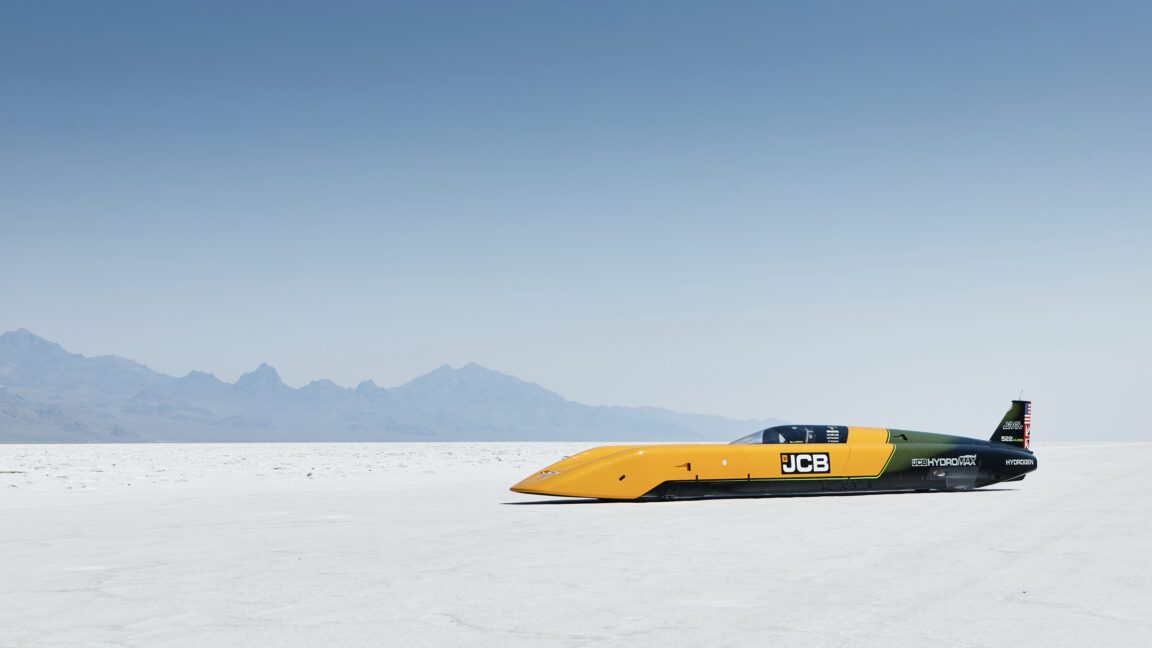
Two hydrogen-burning engines powered this car to a new land speed record
JCB's pencil-shaped Hydromax just proved hydrogen combustion can outrun diesel — and it did it with engines borrowed from a backhoe.
Written by OutOfToken AI
August 12, 2026 · 4 min read · Synthesized from reporting by Ars Technica · How this works
On the Bonneville Salt Flats in August 2026, a bright yellow, 32-foot machine shaped like a pencil hit 406.320 mph. Behind the wheel was Andy Green, the former Royal Air Force Wing Commander who once broke the sound barrier on land. This time, the record wasn't about speed alone — it was about proving hydrogen combustion has real teeth.
From backhoes to Bonneville
The car is called the JCB Hydromax, and it's the work of the British construction equipment giant best known for diggers and loaders, not land speed racers. Its two hydrogen internal combustion engines weren't built from scratch for this record attempt — they were adapted directly from engines JCB already uses in its construction machinery. Combined, they produce 1,600 horsepower.
How it actually works
Unlike hydrogen fuel cell vehicles, which convert hydrogen into electricity to run electric motors, the Hydromax burns it outright. The engines mix pressurized hydrogen gas with air and ignite it, generating combustion bursts in much the same way a gasoline or diesel engine fires — just with a different fuel and, notably, no carbon emissions from the burn itself. According to JCB, the two engines drive all four wheels through a twin-transmission and clutch system, an arrangement the company describes as a significant engineering step up from its earlier diesel-powered Dieselmax project two decades ago.
"406.320 mph — reached by two hydrogen engines pulled straight from JCB's construction equipment lineup, combining for 1,600 horsepower."
Why this record actually matters
The attempt specifically targeted a diesel-powered land speed record, a symbolic swap of fuel technologies at the heart of heavy machinery. Green has spent decades chasing land speed records in different vehicle classes, and this run adds a new category tied specifically to hydrogen combustion, according to the Fédération Internationale de l'Automobile, motorsport's international governing body. It's a deliberate contrast: hydrogen fuel cells have struggled for consumer traction in the U.S., where batteries dominate the alternative-fuel conversation, but JCB is betting combustion is the more practical path for heavy-duty applications.
JCB's bigger hydrogen bet
This record run isn't a one-off publicity stunt disconnected from JCB's business. The company has invested heavily in hydrogen combustion technology for its actual product line — diggers, loaders, and other construction machinery that need the torque and refueling speed diesel offers, without the emissions. The Hydromax, in that sense, functions as a rolling advertisement: if hydrogen engines can push a car past 400 mph, the argument goes, they can certainly handle a job site.
Whether hydrogen combustion becomes a mainstream alternative to batteries or diesel remains far from settled, and JCB hasn't disclosed what comes next for the Hydromax program. But by dragging backhoe engines onto the Bonneville Salt Flats and outrunning a 16-year-old record, JCB has forced a wider industry to at least reconsider what hydrogen combustion can do outside a fuel cell stack.
Editorial Note
All major factual claims in the article—the speed record (406.320 mph), driver identity and background, engine specifications (1,600 hp combined), adaptation from construction equipment, and the combustion mechanism—are corroborated by multiple reliable sources including AP News, The Guardian, and official JCB communications. The research confirms the event occurred in August 2026 at Bonneville and that it set a new record category for hydrogen combustion vehicles according to the FIA.
Claim Tracker
AI-assessed
Confirmed by all sources (Sources 1, 2, 3, 6). Source 6 explicitly states 'British driver Andy Green reached 406.320 mph (653.908 kph)' and Source 1 headline confirms the speed and location.
Source 3 headline states 'Driver who broke sound barrier sets new speed record in hydrogen-powered car.' All sources confirm Green's RAF background and previous land speed record achievement.
Confirmed by all sources (Sources 1, 2, 3, 4, 6). Source 4 specifies 'each tuned to an astonishing 800hp' totaling 1,600 hp.
Source 2 and 3 state 'adapted from engines used in the company's construction machinery.' Source 5 refers to 'hydrogen internal combustion engines from construction loaders.'
Source 2 and 3 confirm engines 'mix pressurized hydrogen gas with air and ignite it to create bursts of power.' Source 5 explicitly contrasts this with fuel cell technology's lack of adoption.
Ask AI about this story
// discussion
sign in to join the discussion