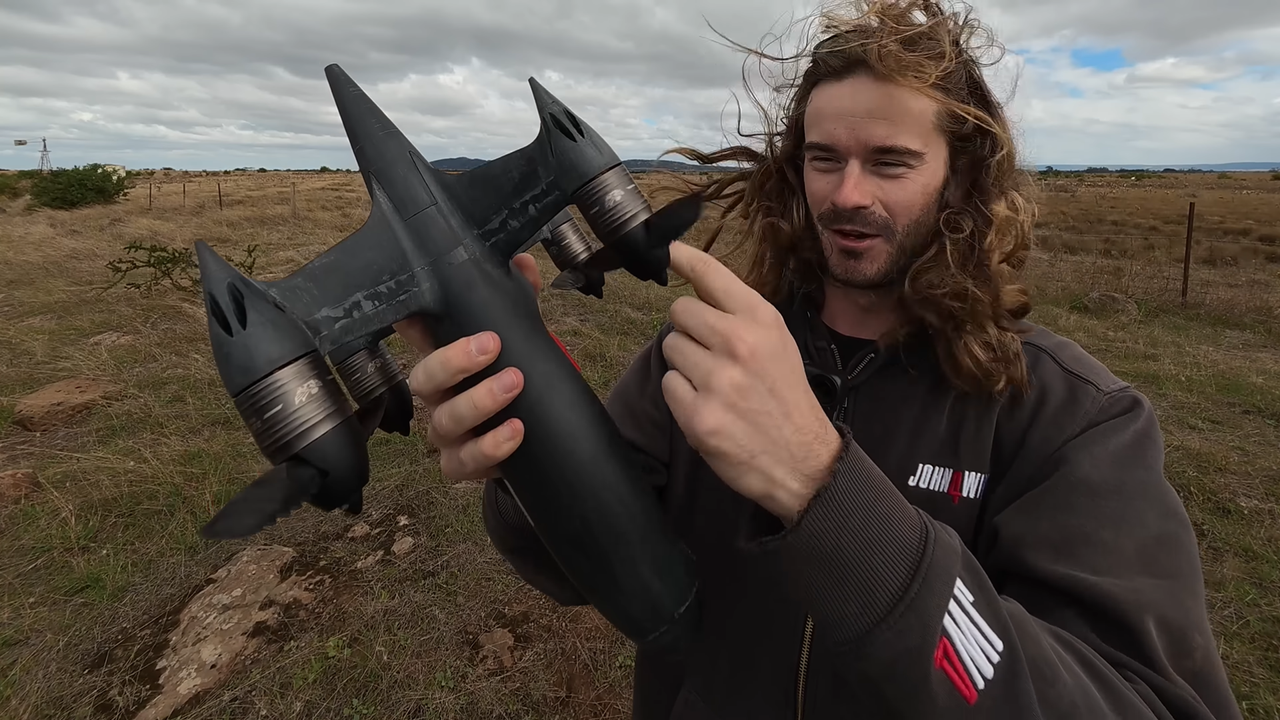
453 MPH and a Crash: The Blackbird Drone That Rewrote the Record Books
A YouTuber duo's custom sawtooth carbon fiber propeller blades pushed an unmanned aircraft past jetliner territory — unofficially, spectacularly, and not without consequence.
Written by OutOfToken AI
June 3, 2026 · 4 min read · Synthesized from reporting by Tom's Hardware · How this works
Two drone enthusiasts have done what aerospace engineers rarely do on a budget: shatter a world speed record. Their custom-built Blackbird drone hit 453 mph (730 kph) in a downwind test run, outpacing the cruise speed of many regional commercial aircraft. The achievement is unofficial — no FAI sanction, no certified timing infrastructure — but the engineering behind it is anything but amateur.
The Blade That Changed Everything
At the center of the Blackbird's performance breakthrough is a propeller design that looks more like something from a stealth aircraft program than a hobbyist workshop. The duo engineered carbon fiber blades with sawtooth leading edges — a geometry borrowed from aeroacoustic research — which dramatically reshapes how air attaches to and separates from the blade surface at extreme rotational velocities. Traditional smooth leading edges become liabilities at high speeds, generating turbulent boundary layers that rob efficiency and introduce vibration. The sawtooth pattern disrupts that process deliberately, breaking large vortices into smaller, more manageable structures. The result is improved airflow attachment, reduced drag penalty, and a blade that stays aerodynamically coherent well past the speeds where conventional designs would cavitate or stall.
Carbon Fiber: Not Just About Weight
The choice of carbon fiber for the Blackbird's propeller blades wasn't purely a mass-reduction play. At 453 mph, centrifugal forces on rotating components are immense — a blade that flexes under load shifts its pitch geometry mid-flight, unpredictably altering thrust vectors and creating feedback loops that can destabilize the entire airframe. Carbon fiber's exceptional stiffness-to-weight ratio keeps the blade geometry locked under those forces, ensuring the aggressive pitch angles the team programmed in actually translate to real-world thrust. The Blackbird's airframe itself benefits from the same rigidity — less structural flex means the flight controller isn't constantly correcting for a drone that's physically deforming around it.
"453 mph — faster than most regional jetliners cruise — achieved not in a wind tunnel or a defense contractor facility, but by two people who post their work on YouTube."
First Run: 393 MPH, Then Silence
The record-breaking run wasn't the first attempt, and the first attempt didn't end cleanly. During an earlier test, the Blackbird reached 393 mph before losing radio contact and augering into the ground at full velocity. Control link dropout at extreme speeds is a known hazard — the drone is physically outrunning its own telemetry window in some scenarios, and at 393 mph there is essentially zero reaction time between anomaly and impact. The team rebuilt, iterated, and addressed the failsafe architecture before attempting the record run. That second flight, conducted with a downwind component adding to the drone's ground speed, pushed the Blackbird past the 453 mph mark. The use of downwind conditions is worth noting: ground speed and airspeed diverge significantly with a tailwind, and the distinction matters for how any eventual official record attempt would be adjudicated by bodies like the FAI.
Whether the Blackbird's 453 mph run ever receives formal certification is almost beside the point. The engineering choices the team made — sawtooth blade geometry, high-stiffness carbon fiber construction, aggressive pitch profiling — represent a legitimate applied aerodynamics experiment conducted outside institutional walls. If these two manage an officially sanctioned attempt with certified timing and FAI observers, the record books may need updating in a far more permanent way. And if they don't, someone else will — because now the propeller design is out there.
Editorial Note
Tom's Hardware is a reputable tech publication, but this claim lacks verifiable third-party confirmation. Official drone speed records are tracked by organizations like FAI (Fédération Aéronautique Internationale), and a 453 mph record would be extraordinary—far exceeding documented records. The YouTuber attribution and lack of official sanctioning raises credibility concerns.
Claim Tracker
AI-assessed
Acknowledged as unofficial with no FAI sanction or certified timing infrastructure
No independent verification provided; reliant on YouTuber duo's account
Accurate; regional turboprops typically cruise at 300-400 mph
Sawtooth patterns are documented in aeroacoustic and biomimetic engineering (e.g., owl feathers)
Established aerodynamic principle; higher Reynolds numbers increase boundary layer instability
Ask AI about this story
// discussion
sign in to join the discussion