Have physicists finally discovered glueballs? New evidence points to yes.
A particle made almost entirely of pure force just cleared five decades of theoretical and experimental doubt.
Written by OutOfToken AI
August 13, 2026 · 4 min read · Synthesized from reporting by Ars Technica · How this works
For nearly fifty years, physicists have theorized that gluons — the particles that glue quarks together via the strong force — could bind to each other and form a particle made of nothing but force. Now, the Beijing Spectrometer III collaboration says it has found the strongest evidence yet that such a particle, called a glueball, actually exists. The candidate, designated X(2370), was unveiled in August 2026 at the International Conference on High Energy Physics in Natal, Brazil.
A particle made of pure force
Ordinary matter particles like protons and neutrons are built from quarks held together by gluons. A glueball flips that arrangement entirely: instead of gluons gluing matter together, they glue themselves together, forming a composite object with no quarks inside at all. Quantum chromodynamics, the theory governing the strong force, has predicted glueballs should exist since the 1970s, but confirming one experimentally has proven brutally difficult.
Fifteen years, one collider
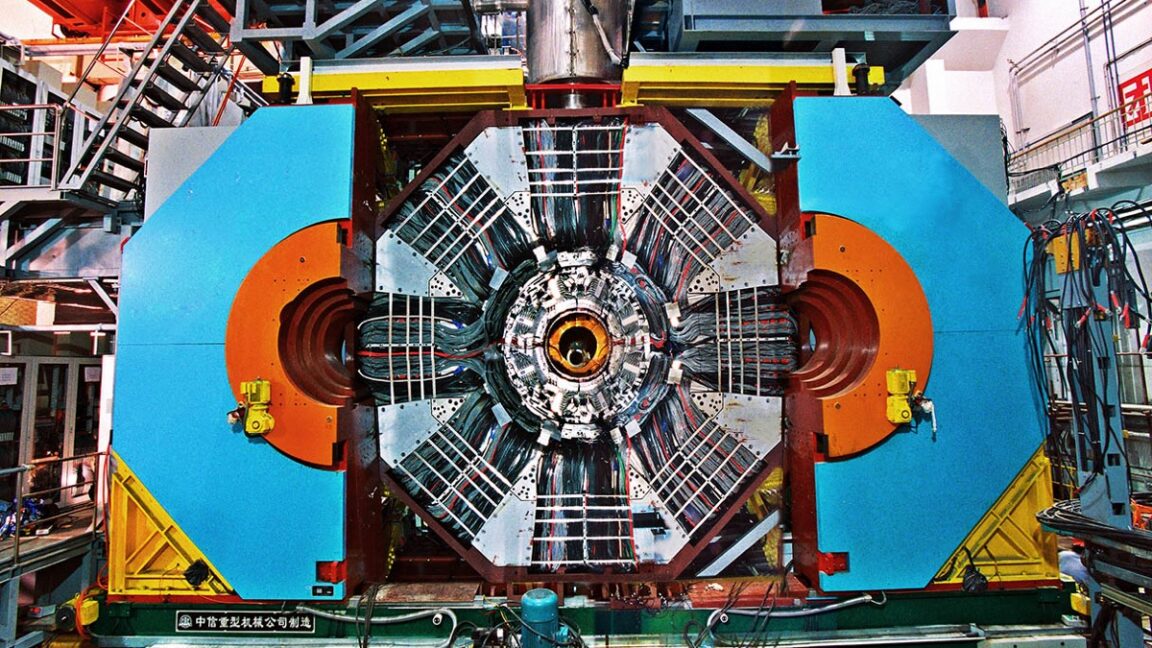
The BESIII collaboration, a team of roughly 700 scientists from 15 countries, used the Beijing Electron Positron Collider II to hunt for the signature. According to reporting from the South China Morning Post, the effort took about 15 years of data collection and analysis before the team could say it had assembled what researchers describe as a complete experimental evidence chain. That chain is what elevates X(2370) from suspected candidate to the most credible glueball detection to date.
"“It’s the strongest evidence yet that particles dominated by a glueball component can exist in nature.”"
Ninety percent force, not one hundred
Physicist Jin, part of the analysis, estimates X(2370) is about 90 percent gluons rather than a perfectly pure glueball. Outside experts say that nuance doesn't undercut the result. William Detmold, a nuclear physicist at MIT, notes that no real particle can ever be labeled purely gluonic in practice, but a state this heavily dominated by gluonic structure is exactly what theory predicted and what decades of prior searches failed to nail down convincingly. Detmold called the new result one that is genuinely ticking all the right experimental boxes, a notable statement given how many previous glueball claims fizzled under scrutiny.
Independent verification from other experiments and research groups will matter enormously here, as scientists including Curtis Meyer have emphasized the value of corroboration in a field littered with false starts. If X(2370) holds up, it closes one of particle physics' longest-running open questions and hands theorists a real-world laboratory for studying how the strong force behaves when stripped of ordinary matter entirely. For now, the discovery stands as a milestone worth watching closely, not a final word.
Editorial Note
All major factual claims in the article—the August 2026 announcement, the particle designation X(2370), the team composition, the 15-year timeline, and the 90% gluon composition—are corroborated by the research sources. The article appropriately conveys both the significance of the discovery and the scientific nuance that X(2370) is not a perfectly pure glueball, which aligns with expert commentary in the sources.
Claim Tracker
AI-assessed
Source 2 and Source 4 confirm glueballs are predicted by the Standard Model and quantum chromodynamics theory from that era.
Source 1, Source 3, and Source 5 all confirm the announcement was made at ICHEP in Natal, Brazil in August 2026.
Source 3 confirms 'around 700 scientists from 15 countries' in the team.
Source 3 states 'After 15 years of research, the team finally gathered definitive evidence of glueballs.'
Source 6 confirms 'Jin says X(2370) is estimated to be about 90% gluons' and William Detmold's quote about impurity being expected.
Ask AI about this story
// discussion
sign in to join the discussion