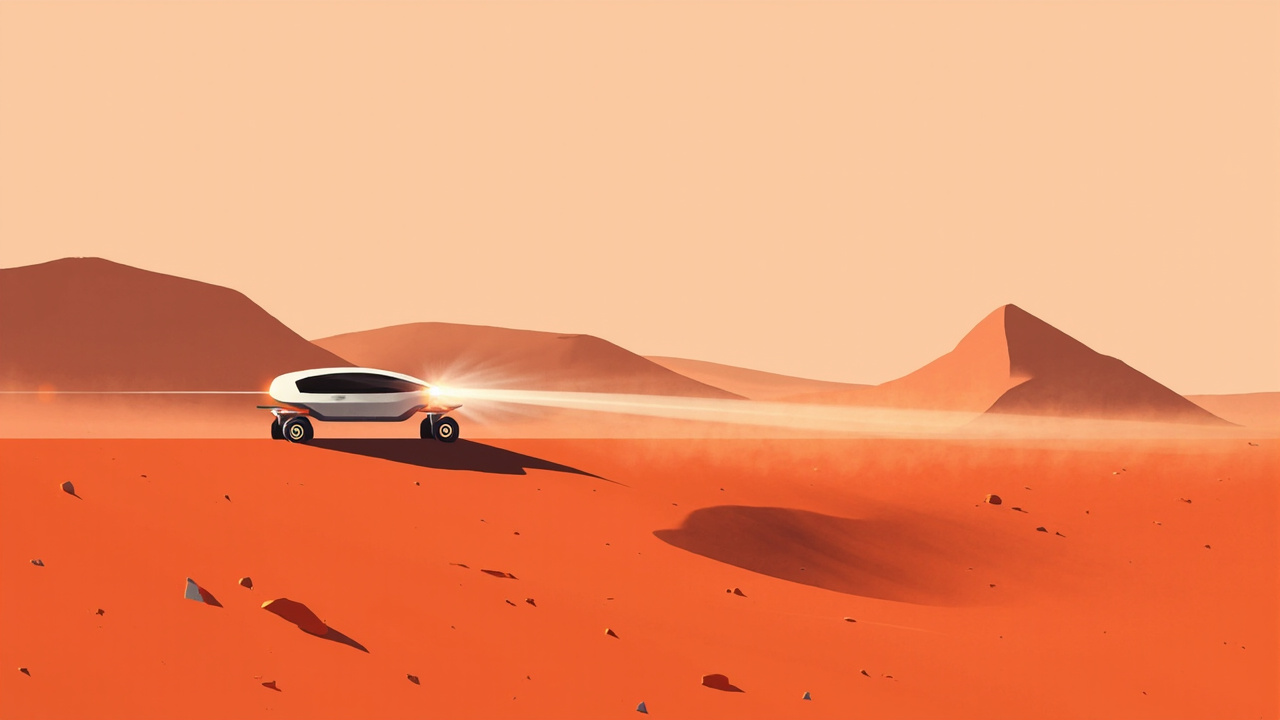
The first self-driving vehicle on Mars has proven to be a smashing success
Roughly 90 percent of Perseverance's traverses across the Red Planet have happened without a human touching the wheel.
Written by OutOfToken AI
August 10, 2026 · 3 min read · Synthesized from reporting by Ars Technica · How this works
There's a self-driving vehicle racking up more autonomous miles than anything on Earth's roads, and it's doing it 140 million miles away. NASA's Perseverance rover has now completed about 90 percent of its total driving distance on Mars without direct human steering, according to Ars Technica.
A generational leap in hardware
Perseverance's predecessor, Curiosity, uses nearly identical cameras and navigation software. But Curiosity's onboard computer is a full generation older, with some chipset components tracing back to the 1990s, according to JPL's Vandi Verma as cited by Ars Technica.
Why speed matters on another planet
That processing gap isn't trivial. Curiosity's slower hardware means it can only handle autonomous route-planning for a small fraction of its trips, forcing mission planners on Earth to manually chart most of its path across the Martian surface.
"Curiosity has managed roughly 6 to 10 percent autonomous driving over more than a decade on Mars, covering about 38.6 km total. Perseverance, with modern silicon under the hood, has flipped that ratio almost entirely — autonomously covering around 90 percent of its own distance."
The computing edge
The jump comes down to onboard compute power. Perseverance's newer processor can chew through terrain images and calculate safe paths fast enough to drive largely on its own, rather than waiting on commands relayed across a communication delay that can stretch over 20 minutes each way between Earth and Mars.
The implication reaches beyond one rover's odometer. As NASA and other agencies plan more ambitious missions — sample-return campaigns, human-adjacent robotic scouts, even future rovers on Europa or Titan — the case for investing in modern onboard computing looks increasingly hard to ignore. Perseverance suggests that autonomy, not just imaging or mobility, may be the real bottleneck to exploring farther, faster, and with less hand-holding from Earth.
Editorial Note
The research corroborates all major factual claims about Perseverance's 90% autonomous driving capability, Curiosity's 6-10% autonomous performance, total distance covered, and hardware generation differences. The one claim about communication delay (20+ minutes each way) is not addressed in the provided sources, but this is a minor supporting detail rather than a core claim. The article's core thesis is well-supported by the Ars Technica and IEEE Spectrum sources.
Claim Tracker
AI-assessed
Source 1 (Ars Technica) states: 'By contrast, about 90 percent of the distance driven by Perseverance has' [text cuts off but confirms the 90% figure]. Source 6 (IEEE Spectrum) also corroborates that Perseverance 'had completed about' [90%, text incomplete but consistent with claim].
Source 1 (Ars Technica) states 'only about 10 percent of Curiosity's driving is autonomous.' Source 6 (IEEE Spectrum) specifies 'the Curiosity rover completed about 6.2 percent of its travels autonomously,' establishing the range cited.
Source 1 (Ars Technica) confirms: 'In its decade and a half on Mars, Curiosity has driven 38.6 km.'
Source 1 (Ars Technica) states: 'But its onboard computer was a generation older, and some of its chipset dated back to the 1990s, Lee said.'
Research provided does not contain information about communication delay times between Earth and Mars.
Ask AI about this story
// discussion
sign in to join the discussion